
Teaching Innovation in Routine Schools?

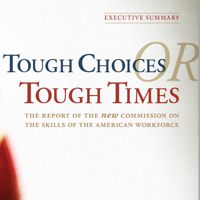
Tough Choices or Tough Times

On December 14, 2006,  the New Commission on the Skills of the American Workforce, unveiled a report which should keep educators and policy-makers talking for months to come. Tough Choices or Tough Times, offers both a sober assessment of the challenge (Tough Times) and a radical proposal for reform of our educational system (Tough Choices). Executive Report  1.9MB pdf

Already the report is drawing both praise and heavy criticism. See: “U.S. Urged to Reinvent Its Schools” Education Week December 20, 2006. More 35kb pdf

The report assesses the demands of the information age / global economy against the current trends in American education. In our efforts to shore up the basic competencies of our students we have sacrificed creativity. Our schools have been taken over by the “test-prep” mentality. Typically that involves putting our student through relentless repetition of formulaic approaches to finding “the right answer.” More

As Washington considers the reauthorization of NCLB, I hope someone asks the question, “Why are we training our students to perform routine tasks, when routine work is increasingly done by machines and low-wage labor?”

As Tough Choices or Tough Times states, “A swiftly rising number of American workers at every skill level are in direct competition with workers in every corner of the globe. …If someone can figure out the algorithm for a routine job, chances are that it is economic to automate it. Many good well-paying, middle-class jobs involve routine work of this kind and are rapidly being automated.
…The best employers the world over will be looking for the most competent, most creative, and most innovative people  on the face of the earth and will be willing to pay them top dollar for their services. This will be true not just for the top professionals and managers, but up and down the length and breadth of the workforce.
…Strong skills in English, mathematic: technology and science, as well as literature, history, and the arts will be essential for many; beyond this, candidates will have to be comfortable with ideas and abstractions, good at both analysis and synthesis, creative and innovative, self-disciplined and well organized, able to learn very quickly and work well as a member of a team and have the flexibility to adapt quickly to frequent changes in the labor market as the shifts in the economy become ever faster and more dramatic.”

To prepare our students to lead productive and fulfilling lives, they will need both core competencies and opportunities to explore creative solutions that are “outside the box.” Let’s not forget “synthesis” – one of Bloom’s higher-order thinking skills. It’s been defined as: “Creatively or divergently applying prior knowledge and skills to produce a new or original whole.”

We can’t blame teachers for abandoning project-based learning when they get the message that we have to get “the scores up.” It’s time to refine our thinking about educational accountability.  We will need to produce a new generation of students with both solid skills and the ability to apply them in new and creative ways.

As the report concludes, “Creativity, innovation, and flexibility will not be the special province of an elite. It will be demanded of virtually everyone who is making a decent living, from graphic artists to assembly line workers, from insurance brokers to home builders.”

See new post “Teaching innovation in routine schools? Part II”

Parents’ Literacy Publishing Project

I’m very excited by a project designed by a Patricia Martin, a friend and colleague. The project engaged parents as literacy partners with their children. It included opportunities for parents to reflect on their learning and reading experiences with their children. Pat documented the entire project in a book, published using print on demand technology. For more information on how you and your students can publish your own books visit our website Read > Think > Write > Publish

Pat describes the project:

“The increased attention to high-stakes testing and charter schools should re-emphasize the need for public schools to engage parents, as well as, students in the daily classroom learning experiences.  Of course, it’s not the Parent Association, room mother, field trip chaperon who needs a nudge to be involved in school activities.  Disengaged parents may be new to a school district, occupied with child-rearing responsibilities, isolated by culture or language or a victim of negative school experiences.  Some districts have found successful methods for reaching out to the disengaged parent.

The Parent Project is one district’s response to the growing absence of parent involvement.  Based on the work of James Vopat, The Parent Project – A Workshop Approach to Parent Involvement, the district created a planning team that included several parents to plan and implement a series of parent workshops. During each workshop the parent leaders and teachers coached targeted parents to become partners in their child’s literacy development.

The workshops were planned to include fun, learning and reflection. As much as possible, the parents experienced learning much as their child would in the classroom. Parents were given the opportunity to practice each session’s learning with their child through carefully designed take-home activities.  The next session began with a sharing of parental insights during these practice activities.  Parents and teachers captured their experience in a personal journal.

Additional characteristics of the Vopat model build a sense of community and shared commitment among the participants. 
• Family meal with teachers and administrators before each workshop
• Child care for all children during the workshop
• Transportation to the workshops

The final product, beyond a published book, was evident.  The five original teachers elected to remain on the CORE team and five additional teachers volunteered to join the CORE team for the next training session.  Three-fourths of the parents elected to form a Parent Alumni Group to continue the workshop experience.   Half of those parents also volunteered to serve as Parent Leaders with the next set of parents.  Parents “graduates” of The Parent Project are volunteering in classrooms because they believe that they are an integral part of the educational scene.”

Pat’ blog “Literacy is All” / email

Foster Higher Order Thinkers

This week I was in the metro-Detroit area giving a workshop at the St. Clair County Regional Educational Service Agency in Maryville, MI. The one-day session was sponsored by the Successful Practices Network.

We focused on techniques for fostering student skills in higher-order thinking and problem solving.  Participants included high school teachers and administrators.  I used my TurningPoint audience response system and posed questions which probed participant expectations of students and instructional strategies. The system allows me to capture participant thinking and use it foster some lively discussion and reflections. You have to model what you preach, so we worked through some higher-order thinking and problem solving ourselves. Participant feedback on workshop strengths included:

“Practical strategies that can be immediately implemented.”
“The way Peter took us through the response process modeled the struggle our students would go though in class.”
“He challenged our thinking with the data we submitted with the response units.”
“We convinced ourselves that our students / all students can think and perform at higher level.”

Updated handout with audience response data Download pappas-handout-stclair.pdf 1.8 MB pdf.

For more information on TurningPoint contact Mike Venrose at mvenrose@turningtechnologies.com

Strategies for Rigor and Relevance

I just returned from an engaging one day workshop with over 100 high school teachers and administrators from the Green Bay Wisconsin area (sponsored by CESA 7).
I brought my TurningPoint audience response system to gather feedback and generate discussion on some essential questions:

1. What does rigor and relevance look like in the classroom?
2. To what extent is learning student- or teacher directed?
3. How can I help build literacy and still teach my content?

Here’s some comments from the participant evaluation:

“Well-organized, interactive and well structured. Peter demonstrated  his own method for rigor and relevance while teaching us, so we participated as our students would”
“Changed the way I will instruct my student. And changed my expectation of my students as well.”
“The workshop was effective because you made us reflect on our classroom practice and our expectations of students. Then you supplied us with techniques and strategies to improve instruction.”

Updated handout with audience response data Download pappas-cesa7-handout.pdf 1.8 MB pdf

Essential Skills for Today’s School Leaders

North Carolina's Principals’ Executive Program (PEP), is the first and longest-running program of its kind in the United States. PEP is an excellent example of how rigorous, research-based training in modern leadership techniques and instructional strategies can improve teaching and learning in America’s public schools.

I am pleased to be one of the speakers at PEP's 2006 Statewide Leadership Conference “Essential Skills for Today’s School Leaders.” 

Rigor, Relevance and Content Reading Strategies
Download pappas-rigor-NC-PEP.pdf PPT Handout 3.6 MB pdf   
Download PeterPappas-rigor-relevance.WMA  2 hour Audio 30MB wma
This session demonstrates how educators can boost achievement with a consistent focus on common instructional strategies in a student-centered classroom. The presentation includes practical examples of how school leaders can support content mastery and build student literacy skills in vocabulary, comprehension and analysis. For more information visit my site Content Reading Strategies that Work
In this session we used my TurningPoint audience response system to gather feedback and guide our discussion. TurningPoint can produce a variety of reports and can even track results by individual responder. Want to know more about TurningPoint response systems? Contact Mike Venrose at mvenrose@turningtechnologies.com

Publishing – Academic Success for Struggling Readers and Writers
Download pappas-publish-NC-PEP.pdf PPT Handout 3.5 MB pdf 
Download PeterPappas-digital-publishing.WMA 1 hour Audio  14MB wma
This session offers examples of publishing programs that have successfully helped struggling readers and writers, strategies for incorporating publishing workshops into your school's curriculum, and simple technology tips that produce good results. For more information visit my site Read > Think > Write > Publish